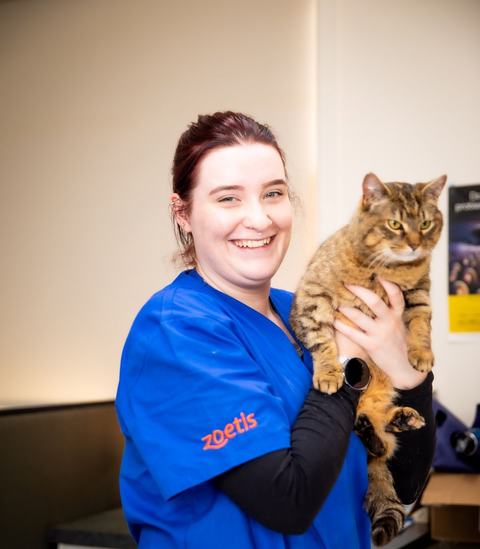
All courses below are compulsory for the Companion Animal Strand.
ANML3101 – Introduction to Professional Skills when working with companion animals
Credits: 15
- Identify the impact of legislation and Codes of Welfare on companion animal facilities.
- Describe the interpersonal skills and professional competencies required in a companion animal facility.
ANML3102 – Introduction to behaviour, handling and transportation for companion animals
Credits: 15
- Identify a range of companion animal breeds, and methods for identifying individual animals in an animal care context.
- Describe safe handling, restraint, basic training, and transportation techniques for a range of companion animals in an animal care context.
ANML3103 – Introduction to form, function and preventative health for companion animals
Credits: 15
- Identify anatomical structures and their basic functions in companion animals.
- Describe preventative health and hygiene measures to maintain the health and wellbeing of companion animals in an animal care context.
ANML3104 – Introduction to Husbandry for companion animals
Credits: 15
- Describe a holistic approach to companion animal husbandry which supports optimal health and welfare in an animal care context.
- Explain basic reproduction, parturition and care of neonates in companion animals in an animal care context.
- Explain how to apply basic first aid to companion animals in a range of emergency situations in a companion animal context.
ANML3105 – Companion Animal Practicum
Credits: 10
- Demonstrate professional and ethical behaviour in a team environment in companion animal facilities.
- Provide day-to-day feeding, husbandry, handling and routine health procedures to maintain the welfare of animals in a companion animal facility.
- Apply health and safety, legal, and welfare practices to working in companion animal facilities.
This qualification must include at least 40 hours of Practicum in a workplace environment that provides opportunity for candidates to practice and apply the skills and knowledge inherent in the qualification outcomes.
Transition Plan
Transitions to follow this table, however, the Programme Operations Manager has the discretion to approve variations to these based on the intention that ākonga should not be disadvantaged by these transition arrangements.
ANML3101 – Introduction to Professional Skills when working with companion animals (15 credits)
SIT Version:
- No equivalent paper
- RPL for work experience or previous learning (RPL for transition arrangements is free of charge)
ANML3102 – Introduction to Behaviour, handling, and transportation for companion animals (15 credits)
SIT Version:
- ACS102 – Ethical and legal behaviour in relation to Animals (7 credits)
With any 3 papers below:
- ACS106 – Dog identification, health and Housing (10 credits)
- ACS109 – Rodent identification health and housing (10 credits)
- ACS108 – Poultry identification health and housing (10 credits)
- ACS111 – Cat identification health and housing (10 credits)
ANML3103 – Introduction to form, function, and preventative health for companion animals (15 credits)
SIT Version:
- ACS100 – Zoonoses and their control (8 credits)
- ACS101 – Animal anatomy and Physiology (10 credits)
- ACS103 – Normal and abnormal animal behaviours (5 credits)
- ACS104 – Basic animal health procedures and first aid (5 credits)
Need to complete all papers.
ANML3104 – Introduction to Husbandry for companion animals (15 credits)
SIT Version:
- No equivalent paper
ANML3105 – Companion Animals PRACTICUM (10 credits)
SIT Version:
- No equivalent paper
Follow SIT