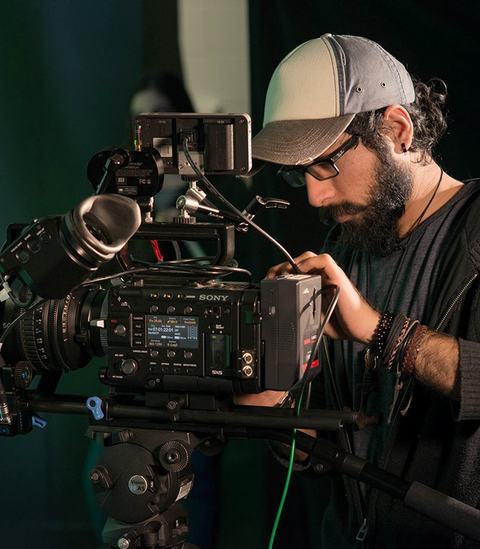
New Zealand Diploma in Screen Production (Level 5)

Dive into video production with the New Zealand Diploma in Screen Production! This programme covers all the essentials you need to break into the visual storytelling industry or enhance your hobby.

Campus
SIT Online
Qualification
Diploma
Level
5
Credits
120
Duration

One year full-time

Up to four years part-time

Intakes are 17 weeks long

Dates
TBC
Fees
This programme qualifies for SIT Zero Fees. Terms and Conditions apply. Click here for more information.
Tuition Fees

Zero tuition fees

Direct Material Costs

$7.00 per credit (incl. GST)

International Fees

$100 per credit (incl. GST). See International.

Course Outline

Get into video production with the New Zealand Diploma in Screen Production and learn all the basics that you need to get into the visual storytelling industry or upskill your hobby.

This introductory diploma will cover all the basics that you will need to know about screen production and help you develop necessary creative and technical skills.

You will learn:

  • Introduction to Screen Production
  • Screenwriting
  • Editing for Screen
  • Screen Culture and Context
  • Screen Business Practices
  • Pre-Production Planning
  • Screen Production Practices
  • Practical Screen Production
Course Content

DSP501 Introduction to Screen Production (15 credits)

This paper provides an introduction to the principles and processes of modern screen production. Students will learn fundamental digital camera skills, an understanding of the importance of lighting, sound, and other creative and technical principles that underpin good screen production

DSP502 Screenwriting (15 credits)

This paper introduces the elements of conventional film narrative, and storytelling. Students will develop their writing skills through a critical understanding of dramatic structure, story fundamentals, and the screenwriting process.  

DSP503 Editing for Screen (15 credits)

(Please note: This paper has an additional course related cost of $139.50 as we will be supplying a 1Tb Hard Drive loaded with high quality footage for your DSP503 tasks and assignments. At the completion of the paper, you may retain your hard drive)

This paper deals with the practicalities and aesthetics of combining moving images. It will introduce students to fundamental postproduction tools and techniques including, non-linear editing systems, grading, and use of sound to create unity in and between scenes. Techniques include screen direction, timing, L and J cuts, and exporting in appropriate formats based on delivery requirements. 

DSP504 Screen Culture and Context (15 credits)

This paper will outline the developments in screen history through the culture and context of the times, evaluating social, economic, and cultural influence on technique, genre, story, and style. It will analyse how these developments continue to influence the modern screen production industry dictating in many ways what projects are produced, where, and whose stories are told.

DSP505 Screen Business Practices (15 credits)

This paper will introduce students to screen production business practices and their use in the process of creating film projects. These will include, project inception, legal requirements, contracts, copyright, work hours and rules, the blue book, product distribution and other relevant areas of production.

DSP506 Pre-Production Planning (15 credits)

This paper will provide students with the necessary knowledge to pre-produce a narrative screen production while adhering to standard industry practices and Health and Safety legislation. It will cover project and department structure, schedules, budgets, documentation, and previsualization including artwork, and mood boards.

DSP507 Screen Production Practices (15 credits)

This paper will emphasize the critical importance of teamwork and communication in screen productions. Students will learn the value of working with and supporting other content producers, and how this can lead to the creation of works that are far more than the sum of their parts.

DSP508 Practical Screen Production (15 credits)

This paper will further develop and bring together creative, technical, and problem-solving skills learnt in previous papers. Students will create their own short film screen production using these skills and appropriate screen production processes.

Career Opportunities

Graduates of the New Zealand Diploma in Screen Production will have the skills and knowledge to work in junior technical or assistant roles in a screen production environment.

Recent graduates of the New Zealand Diploma in Screen Production have gained temporary roles on film crews, and/or used their newly developed skills for personal screen production projects.

Application Criteria

School Leavers

All applicants should hold NCEA Level 2 or equivalent skills and knowledge, and demonstrate a keen interest in screen production, applicants are also required to submit a portfolio of their work with their application. 

Mature Applicants

Applicants of 20 years of age or over, at the time of programme entry, should demonstrate an interest and aptitude for screen production which demonstrate potential for success.  Examples may include completion of a programme of study at Level 2 or above in a related discipline and/ or employment in a related field for two or more years. They may be admitted subject to programme regulations approved by the Head of Faculty in consultation with the Programme Manager as appropriate.  Personal commitment and a belief in one’s own ability to succeed are important personal traits and will always be taken into consideration during the selection process.

Special Admission  

Notwithstanding the above admissions categories, in exceptional circumstances, a mature aged applicant who can show evidence of ability to succeed in the programme (e.g. strong work experience/background as evidenced by CV, or referee attestations) may be considered for admission provided the applicant has successfully completed an approved course or programme, which is deemed to prepare graduates for the required academic standard for entry.

English Language Requirements

Applicants, whose first language is not English, or who come from a country where the language of instruction in schools is not English, are required to provide evidence of having achieved one of the following:

NCEA Level 3 with University Entrance, or

an International Baccalaureate Diploma or Cambridge A- level qualification for which the teaching and assessment was conducted in English; or

Cambridge Certificate in Teaching English to Speakers of Other Languages (CELTA), or Trinity College London Certificate in Teaching English to Speakers of Other Languages (CertTESOL); or

Successful completion of all primary education (being the equivalent of New Zealand primary school years 1 to 8) and at least three years of secondary education (being the equivalent of three years from New Zealand secondary school years 9 to 13) at schools in  either New Zealand, Australia­, Canada, the Republic of Ireland, South Africa, the United Kingdom and the United States one of the countries listed in Rule 18.5 where the student was taught using English as the language of instruction; or

Successful completion of at least five years of secondary education (being the equivalent of New Zealand secondary school years 9 to 13) at schools in either New Zealand, Australia, Canada, the Republic of Ireland, South Africa, the United Kingdom and the United States where the student was taught using English as the language of instruction; or

Successful completion of a Bachelor ‘s Degree, Graduate Certificate, Graduate Diploma, Bachelor Honours degree, Postgraduate Certificate, Postgraduate Diploma, Masters’ Degree or Doctoral Degree, the language of instruction of which must be in English and which must be  from a tertiary education provider from New Zealand, Australia, Canada, the Republic of Ireland, South Africa, the United Kingdom or the United States or

Successful completion of one of the following internationally recognised proficiency tests listed below to the level required of the programme of study and with all scores achieved in a single test during the two years preceding the proposed date of enrolment.

Diploma at Level 5

  • IELTS test - Academic score of 5.5 with no band score lower than 5
  • TOEFL Paper based test (pBT) - Score of 550 (with an essay score of 5 TWE)
  • TOEFL Internet based test (iBT) - Score of 46 (with a writing score of 14)
  • Cambridge English Examination – B2 First or B2 First for schools with a score of 162.  No less than 154 in each skill
  • OET - Minimum of Grade C or 200 in all sub-tests
  • NZCEL - Level 4 (General) or (Employment)
  • Pearson Test of English (Academic) - PTE (Academic) score of 42 with no band score lower than 36
  • Language Cert - B2 Communicator International ESOL Written (LRW) HIGH PASS with no less than 25/50 in each skill and Spoken (S) PASS
  • Trinity ISE - ISE II with no less than merit in any band
Qualification Pathways

For those wishing to pursue further study, SIT offers

  • Diploma in Animation
  • Diploma in Screen Production
  • Diploma in Screen Production (Game Design)
  • Bachelor of Screen Arts – Animation Major
  • Bachelor of Screen Arts – Game Design Major
  • Bachelor of Screen Arts – Concept Art Major
  • Bachelor of Screen Arts – Film Major
Are you a domestic or international student?

By submitting this form, I agree to the Privacy Notice and consent to receiving email communications from Southern Institute of Technology and its business divisions about learning options, services, news and events.